AQI to Cigarette Calculator
Enter your local Air Quality Index to see how many cigarettes worth of pollution you’re inhaling — based on peer-reviewed PM2.5 research.
| AQI Category | AQI Range | Cigs/day (8h adult) |
|---|
The most accurate, free AQI to Cigarette Calculator available online. Enter your city’s Air Quality Index and instantly discover how many cigarettes’ worth of pollution you are breathing — based on peer-reviewed PM2.5 science and EPA breakpoints. No login. No app. Works on any device.
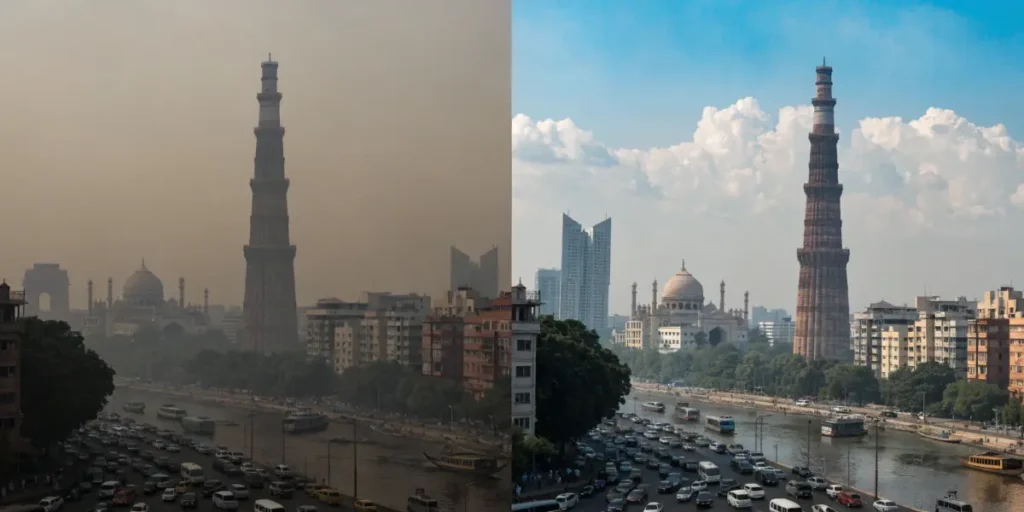
Updated 2026: All calculations use current US EPA AQI breakpoints and the Berkeley Earth cigarette equivalence model. Results include age-group sensitivity adjustments for children and seniors.
What Is the AQI to Cigarette Calculator?
The AQI to Cigarette Calculator is a free online tool that translates the abstract Air Quality Index number into something immediately understandable: how many cigarettes you are effectively smoking by breathing the air around you.
It does this by converting AQI into a PM2.5 particle concentration, then applying the Berkeley Earth formula, which equates 22 μg/m³ of PM2.5 to one cigarette smoked per day.
At its simplest, you enter three things: your current AQI value, how many hours per day you spend outdoors, and your age group. The calculator returns your daily cigarette equivalent, your annual equivalent, the PM2.5 concentration, the estimated life-minutes lost, and personalised health advice.
Why this matters: According to the World Health Organisation, ambient air pollution causes approximately 4.2 million premature deaths worldwide each year. Yet the AQI number on weather apps means little to most people. Framing pollution in terms of cigarettes — a universally understood health risk — makes invisible danger immediately visible and actionable.
AQI Cigarette Calculator vs. Other Air Quality Tools
| Feature | AQI Cigarette Calculator (this tool) | Generic AQI Apps |
|---|---|---|
| What it tells you | Cigarettes smoked + PM2.5 + life-minutes lost | AQI number and colour only |
| Age sensitivity | Separate multipliers for children, adults, seniors | None |
| Hours outdoors | Adjustable 0–24h input | Assumes full 24h |
| Scientific basis | Berkeley Earth PM2.5 model + EPA breakpoints | EPA colour scale only |
| Login required | No | Varies |
| Health advice | Personalised per AQI band and age group | Generic text |
What Does the AQI Cigarette Calculator Measure?
The calculator covers three key dimensions of your daily pollution exposure. Understanding each helps you make smarter decisions about when and where to be outdoors.
| Metric | What It Measures | Why It Matters |
|---|---|---|
| Cigarettes today | PM2.5-based cigarette equivalent for your outdoor hours | Instantly relatable health comparison |
| Annual equivalent | How many cigarettes you smoke per year at this AQI | Shows the cumulative long-term burden |
| PM2.5 concentration | Fine particle density in the air (µg/m³) | The actual physical pollutant doing the damage |
| Life-minutes lost | Estimated healthy life lost per exposure day | Motivates protective action |
The Science Behind AQI to Cigarette Conversion
The cigarette equivalence model was popularised by Richard Muller and Elizabeth Muller of Berkeley Earth.
Their research established that breathing air with 22 micrograms per cubic metre (μg/m³) of PM2.5 particles for 24 hours delivers a dose of fine particulate matter comparable to smoking one cigarette. This benchmark has been widely cited in public health communication and academic literature.
How AQI Converts to PM2.5
The US Environmental Protection Agency (EPA) publishes official AQI breakpoints that map AQI values to PM2.5 concentration ranges. These breakpoints form the backbone of our calculator. Here is the full conversion table:
| AQI Range | AQI Category | PM2.5 Range (μg/m³) | Cigarettes/Day (8h adult) |
|---|---|---|---|
| 0–50 | Good | 0–12.0 | 0.00–0.27 |
| 51–100 | Moderate | 12.1–35.4 | 0.28–0.80 |
| 101–150 | Unhealthy for Sensitive Groups | 35.5–55.4 | 0.80–1.26 |
| 151–200 | Unhealthy | 55.5–150.4 | 1.26–3.42 |
| 201–300 | Very Unhealthy | 150.5–250.4 | 3.42–5.69 |
| 301–400 | Hazardous | 250.5–350.4 | 5.69–7.97 |
| 401–500 | Extremely Hazardous | 350.5–500.4 | 7.97–11.37 |
The Scientific Formula
Our calculator uses a two-step formula:
- Convert AQI to PM2.5 concentration using EPA linear interpolation between official breakpoints.
- Apply the Berkeley Earth cigarette equivalence: Cigarettes per day = (PM2.5 × Hours÷24) ÷ 22
Formula: Cigarettes = (PM2.5 × Hours ÷ 24) ÷ 22
For children (under 18), we apply a 1.5× sensitivity multiplier, as their lungs are still developing and they breathe more air relative to body weight. For seniors (65+), we apply a 1.3× multiplier, accounting for reduced respiratory reserve and higher vulnerability to cardiovascular effects.
Example Calculations
| Scenario | AQI | Hours Outdoors | Age Group | Cigarette Equivalent |
|---|---|---|---|---|
| Typical Delhi winter day | 250 | 4h | Adult | 2.84 cigarettes |
| Mumbai monsoon (clear) | 45 | 8h | Adult | 0.18 cigarettes |
| Child playing outside (Delhi) | 250 | 3h | Child (1.5×) | 3.20 cigarettes |
| Senior morning walk | 150 | 1h | Senior (1.3×) | 0.47 cigarettes |
| Hazardous wildfire day | 400 | 8h | Adult | 12.12 cigarettes |
How to Use the AQI to Cigarette Calculator — Step-by-Step
The calculator takes less than 30 seconds to use. No account, no download, no city selection required. Follow these four steps:
Find your AQI. Check your local AQI on IQAir, AirVisual, the National Air Quality Index (India: https://airquality.cpcb.gov.in), or your local weather app. Note the current AQI number.
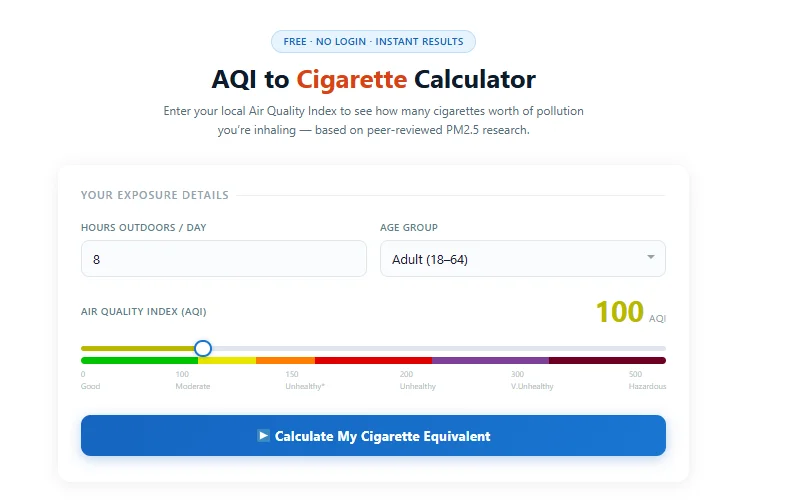
Set hours outdoors. Enter how many hours you spend outside on a typical day. Default is 8 hours. Adjust lower for office workers or higher for outdoor labourers, delivery workers, or athletes.
Select your age group. Choose Child (under 18), Adult (18–64), or Senior (65+). This adjusts the sensitivity multiplier for accurate results.
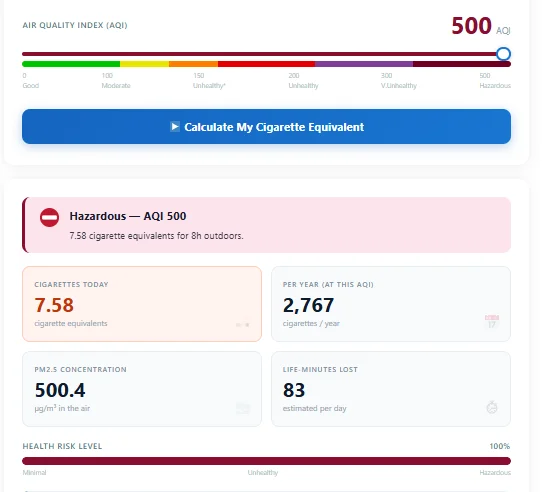
Click ‘Calculate My Cigarette Equivalent.’ Your results appear instantly: cigarettes today, annual total, PM2.5 concentration, life-minutes lost, risk level, and personalised health advice.
Tips for Accurate Results
- Always use today’s real-time AQI, not yesterday’s. AQI can change by 100+ points between morning and evening.
- For children who play outdoors, use 4–6 hours and select the ‘Child’ age group.
- Outdoor construction workers, traffic police, and delivery riders often spend 8–12 hours in polluted air — enter your actual hours.
- The calculator gives your personal exposure based on outdoor time. Indoor air with a good purifier may be significantly cleaner.
- In a city like Delhi during winter, the same AQI can be reached every single day for weeks. Use the annual equivalent figure to understand the cumulative burden.
AQI Categories Explained — What Each Level Means for Your Health
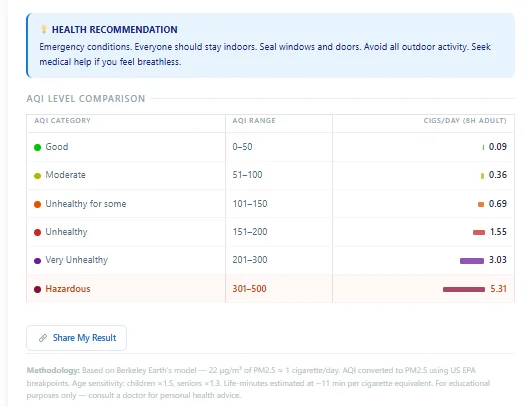
The EPA AQI scale runs from 0 to 500. It is divided into six categories, each with a colour, a health implication, and a corresponding cigarette equivalent.
🌍 Air Quality Index (AQI) — Health Impact Guide
How many cigarettes is the air equivalent to each day?
Understanding which category your city’s air falls into helps you decide whether to go for a run, keep children indoors, or wear a mask.
Good — AQI 0 to 50 (Green)
Air quality is satisfactory and poses little or no health risk. PM2.5 is at or below 12 μg/m³. At AQI 25 and 8 hours outdoors, this equates to approximately 0.11 cigarettes — negligible health impact. No precautions needed for any group.
Moderate — AQI 51 to 100 (Yellow)
Air quality is acceptable. However, unusually sensitive individuals — particularly those with chronic lung disease or severe asthma — may experience minor symptoms. At AQI 75 and 8 hours, equivalent to approximately 0.54 cigarettes per day.
Most people can continue outdoor activity normally.
Unhealthy for Sensitive Groups — AQI 101 to 150 (Orange)
Children, the elderly, and people with asthma, COPD, or heart disease may experience health effects. The general public is unlikely to be affected. At AQI 125 and 8 hours, equivalent to approximately 1.02 cigarettes. Sensitive groups should reduce prolonged outdoor exertion.
Unhealthy — AQI 151 to 200 (Red)
Everyone begins to experience health effects. Sensitive groups are at greater risk. At AQI 175 and 8 hours, equivalent to approximately 2.34 cigarettes. All groups should limit outdoor activity. N95 masks recommended. Run air purifiers indoors.
Very Unhealthy — AQI 201 to 300 (Purple)
Serious health effects for everyone. At AQI 250 and 8 hours, equivalent to approximately 4.55 cigarettes. Avoid all outdoor exertion. Keep windows closed. Anyone with respiratory or heart conditions should stay indoors entirely.
Hazardous — AQI 301 to 500 (Maroon)
Emergency health conditions. At AQI 400 and 8 hours, equivalent to approximately 12.1 cigarettes. The entire population is at risk. Do not go outside. Seal doors and windows. Use heavy-duty air purifiers. Seek medical attention if experiencing chest pain or difficulty breathing.
| AQI Category | AQI Range | PM2.5 (μg/m³) | Cigs/day (8h) | Recommended Action |
|---|---|---|---|---|
| Good | 0–50 | 0–12 | < 0.27 | No precautions needed |
| Moderate | 51–100 | 12.1–35.4 | 0.27–0.80 | Sensitive individuals reduce exertion |
| Unhealthy for some | 101–150 | 35.5–55.4 | 0.80–1.26 | Sensitive groups stay indoors |
| Unhealthy | 151–200 | 55.5–150.4 | 1.26–3.42 | Limit outdoor activity, wear N95 |
| Very Unhealthy | 201–300 | 150.5–250.4 | 3.42–5.69 | Avoid outdoors, air purifier required |
| Hazardous | 301–500 | 250.5+ | 5.69+ | Stay indoors, emergency conditions |
Who Should Use the AQI to Cigarette Calculator?
The AQI to Cigarette Calculator is designed for anyone who breathes outdoor air — which is everyone. But certain groups have more to gain from checking it regularly. No technical background is needed. No account required.
Parents with Young Children
Children’s lungs are still developing, making them significantly more vulnerable to PM2.5 damage. A child spending 4 hours outdoors in AQI 200 air is inhaling the equivalent of 5.28 cigarettes due to their higher ventilation rate and sensitivity multiplier.
Regular checks help parents decide whether to let children play outside, which school routes to use, and whether indoor activity days are needed.
- Most useful input: Set age group to ‘Child’, hours = school + play hours
- Key result: Annual cigarette equivalent shows the cumulative burden if high-AQI days continue
Urban Commuters and Office Workers
Delhi, Mumbai, Kolkata, and Lahore regularly breach AQI 200 in the winter months. A commuter spending 2 hours outside in AQI 250 air absorbs the equivalent of 2.27 cigarettes every working day — or 567 cigarettes across a standard 250-day working year.
Most urban professionals have no idea their commute carries this burden.
- Most useful input: Set hours = actual commute + outdoor lunch time
- Key result: Annual equivalent — compare to an actual smoker (approximately 3,650 cigarettes/year for a pack-a-day habit)
Outdoor Workers
Traffic police, construction workers, delivery riders, street vendors, and agricultural labourers often spend 8–12 hours outdoors in heavily polluted air. These workers face among the highest personal pollution burdens of any group, yet they rarely have access to protective equipment or health information tailored to their exposure.
- Most useful input: Set hours = 10 to 12, age group = Adult
- Key result: Life-minutes lost per day highlights the urgency of protection
Athletes and Fitness Enthusiasts
Running, cycling, and outdoor exercise substantially increase the volume of air inhaled by up to 10 times the resting breathing rate.
While the calculator uses standard breathing rates, outdoor exercise in poor air quality can multiply PM2.5 intake significantly. Athletes should check AQI before morning runs and consider indoor training when AQI exceeds 100.
People with Asthma, COPD, or Heart Disease
Those with chronic respiratory or cardiovascular conditions are classified as ‘Sensitive Groups’ by the EPA and WHO. Even Moderate AQI (51–100) can trigger symptoms in these individuals.
The calculator’s health advice panel provides category-specific guidance for when to limit outdoor activity.
| User Group | Recommended Inputs | Key Output to Watch |
|---|---|---|
| Parents with children | Age: Child | Hours: 4–6h | Cigarettes/year cumulative |
| Urban commuters | Age: Adult | Hours: 1–2h | Annual cigarette equivalent |
| Outdoor workers | Age: Adult | Hours: 8–12h | Life-minutes lost per day |
| Athletes | Age: Adult | Hours: 1–2h (exercise) | Status banner health advice |
| Elderly | Age: Senior | Hours: 2–4h | Daily cigarette equivalent |
| Asthma/COPD patients | Age: Adult | Hours: actual outdoor time | AQI category + personalised advice |
Air Pollution in India and Pakistan — What the Cigarette Equivalent Tells You
South Asia is home to many of the world’s most polluted cities. Delhi, Lahore, Karachi, Dhaka, and Kolkata regularly record AQI values between 200 and 500 during the winter months.
Understanding the cigarette equivalent transforms these abstract numbers into a visceral health reality.
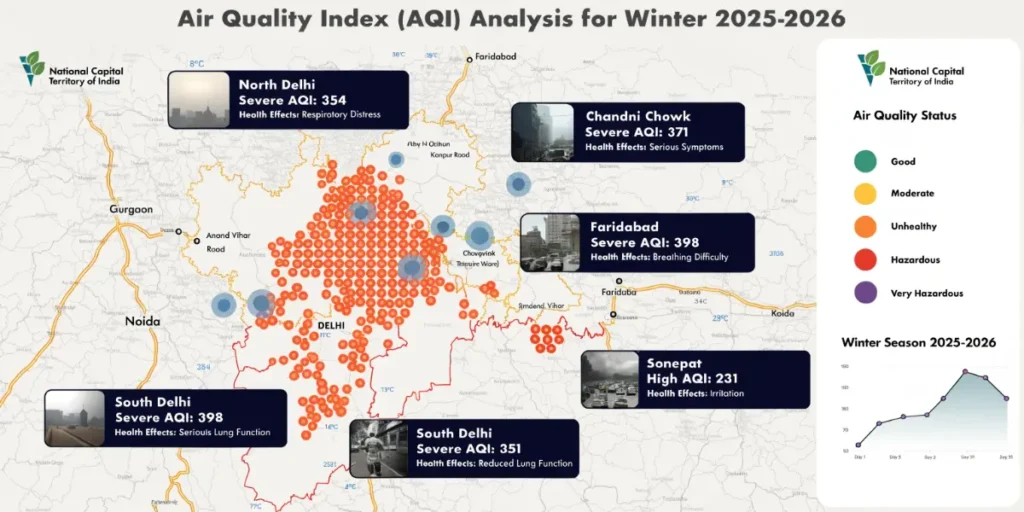
Delhi — AQI Reality Check
Delhi’s average AQI during winter (October–February) typically ranges from 200 to 350, with spikes above 450 during the stubble burning season. At AQI 300 and 8 hours outdoors, a Delhi resident is inhaling the equivalent of 7.95 cigarettes per day.
A child at the same AQI for 4 hours outdoors absorbs 5.96 cigarettes. Over a 5-month winter, the cumulative burden for an adult commuter who cycles to work can exceed 1,200 cigarette equivalents.
Lahore — One of the World’s Most Polluted Cities
Lahore has consistently ranked among the top 5 most polluted cities globally. In November and December, AQI readings of 400–500+ are not uncommon.
At AQI 450 and 8 hours outdoors, the cigarette equivalent reaches 13.6 per day for an adult — the equivalent of nearly a full pack of cigarettes. For a child spending 3 hours outside, the equivalent is 7.6 cigarettes.
What This Means Practically
- A Lahore schoolchild playing outside for 3 hours on a 400 AQI day absorbs the equivalent of 9.1 cigarettes.
- A Delhi traffic policeman working 8 hours at AQI 300 absorbs 7.95 cigarettes per working day — 2,000 per year.
- A Mumbai office worker commuting 1 hour in AQI 150 air absorbs 0.47 cigarettes per day, or 118 per year.
Good air quality cities (AQI below 50) have exposures under 0.3 cigarettes per day, even for outdoor workers.
City AQI to Cigarette Reference (Typical Winter Day, 8h Adult)
| City | Typical Winter AQI | Cigarettes/Day | Annual Equivalent |
|---|---|---|---|
| Lahore, Pakistan | 350–450 | 7.97–10.23 | 2,900–3,700 |
| Delhi, India | 250–350 | 4.55–7.97 | 1,660–2,900 |
| Kolkata, India | 150–250 | 2.57–4.55 | 938–1,660 |
| Mumbai, India | 100–150 | 1.20–2.57 | 438–938 |
| Bangalore, India | 50–100 | 0.27–1.20 | 100–438 |
| Sydney, Australia | 10–30 | 0.05–0.14 | 18–50 |
━━━━━━━━━━━━━━━━━━━━━━━━━━━━━━━━━━━━━━━━━━━━━━━━━━
PM2.5 — The Invisible Killer Behind the AQI Number
PM2.5 refers to fine particulate matter with a diameter of 2.5 micrometres or smaller — roughly 30 times smaller than a human hair.
These particles are generated by vehicle exhaust, industrial emissions, construction dust, crop burning, and indoor cooking on biomass fuels. Because they are so small, they penetrate deep into the lungs and enter the bloodstream, causing damage throughout the body.
Why PM2.5 Is More Dangerous Than Larger Particles
- PM10 and larger particles are filtered by the nose and throat.
- PM2.5 particles pass through these natural filters and reach the alveoli — the deepest part of the lungs.
- From the alveoli, PM2.5 enters the bloodstream and can reach the heart, brain, and other organs.
Long-term exposure is linked to lung cancer, heart disease, stroke, COPD, reduced lung development in children, and dementia.
PM2.5 and Cigarettes — The Parallel
Cigarette smoke is itself a major source of PM2.5. A single cigarette generates approximately 10–40 mg of particulate matter.
The Berkeley Earth formula equates the cumulative PM2.5 dose from breathing polluted air to the PM2.5 dose from smoking, providing a useful — though simplified — comparison.
The comparison is not perfect: cigarette smoke contains additional toxins (benzene, formaldehyde, nicotine) that are not present in typical outdoor PM2.5. However, the cardiovascular and respiratory risk profiles of long-term PM2.5 exposure closely mirror those of smoking.
WHO PM2.5 Guidelines vs. Reality
| Standard | Annual Average PM2.5 (μg/m³) | 24-hour average (μg/m³) |
|---|---|---|
| WHO Guideline (2021) | 5 μg/m³ | 15 μg/m³ |
| India NAAQS standard | 40 μg/m³ | 60 μg/m³ |
| Delhi annual average (2024) | ~90 μg/m³ | Up to 400+ µg/m³ (winter peaks) |
| Lahore annual average (2024) | ~100 μg/m³ | Up to 500+ µg/m³ (winter peaks) |
| London annual average (2024) | ~8 μg/m³ | Rarely exceeds 25 μg/m³ |
Delhi’s annual average PM2.5 is 18 times the WHO guideline. On a bad winter day, breathing Delhi’s air for 24 hours delivers PM2.5 equivalent to approximately 18 cigarettes.
━━━━━━━━━━━━━━━━━━━━━━━━━━━━━━━━━━━━━━━━━━━━━━━━━━
How to Protect Yourself from Air Pollution — Practical Steps
Knowing your cigarette equivalent is only useful if it inspires action. Here are evidence-based steps to reduce your personal PM2.5 exposure, regardless of where you live.
Step 1: Monitor AQI Daily
- Check AQI every morning before deciding on outdoor plans. Use IQAir, AirVisual, CPCB (India), or PEPA (Pakistan).
- Set AQI threshold alerts on your phone: alert at 100 (reduce outdoor activity) and 150 (sensitive groups indoors).
- Use the AQI to Cigarette Calculator to convert the number into something tangible before deciding to exercise outdoors.
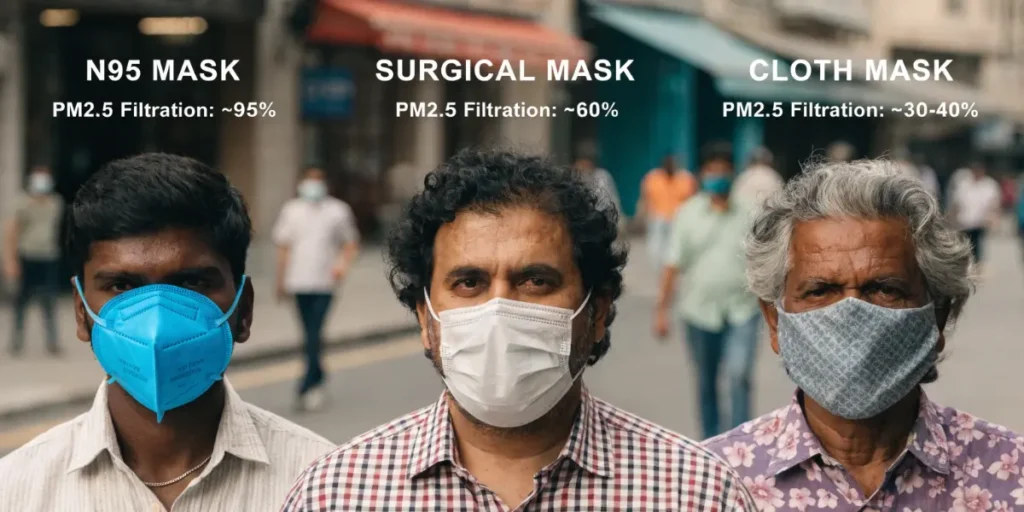
Step 2: Wear the Right Mask
• N95 or FFP2 masks filter approximately 95% of PM2.5 particles. Surgical masks do not protect against PM2.5.
• Cloth masks provide minimal PM2.5 protection and should not be relied upon in AQI above 150.
• Double-strap respirators form a better seal than single-strap respirators. Check for nose wire fit.
• Masks become less effective when damp. Replace after 4–8 hours of use in high-AQI conditions.
Step 3: Use Indoor Air Purifiers
• HEPA air purifiers (True HEPA grade) remove 99.97% of particles 0.3 μm and larger, including PM2.5.
• Run purifiers in bedrooms overnight — PM2.5 can penetrate indoor spaces from outside air.
• Size the purifier for the room: calculate the ACH (air changes per hour) needed. A minimum of 4 ACH is recommended.
• Keep windows closed when the outdoor AQI exceeds 100. The indoor AQI without a purifier typically reaches 60–80% of outdoor levels.
Step 4: Adjust Outdoor Activity Timing
• In most Indian and Pakistani cities, AQI is lowest in the early afternoon (12–3 pm) when solar radiation disperses pollutants.
• Avoid morning and evening outdoor exercise during winter — temperature inversions trap pollutants near the ground.
• If you must exercise outdoors in poor AQI, breathe through your nose (natural filter) and reduce intensity.
Step 5: Reduce Indoor Sources
- Avoid burning incense, agarbatti, or mosquito coils indoors — these are significant PM2.5 sources.
- Use exhaust fans when cooking, especially if using a gas stove. Cooking on biomass or cow dung fuel generates extremely high PM2.5.
- Do not smoke indoors. A single cigarette indoors can raise indoor PM2.5 to over 500 μg/m³ for over an hour.
━━━━━━━━━━━━━━━━━━━━━━━━━━━━━━━━━━━━━━━━━━━━━━━━━━
What Is AQI and How Is It Calculated?
AQI stands for Air Quality Index. It is a standardised scale developed by the US Environmental Protection Agency (EPA) to communicate how clean or polluted the air is, and what associated health effects might be of concern.
AQI combines measurements from multiple pollutants into a single number.
Which Pollutants Does AQI Measure?
| Pollutant | Symbol | Primary Source | Health Effect |
|---|---|---|---|
| Fine particulate matter | PM2.5 | Vehicles, industry, biomass burning | Lung and heart damage |
| Coarse particulate matter | PM10 | Dust, construction | Respiratory irritation |
| Ground-level ozone | O3 | Sunlight + NOx/VOC reactions | Lung inflammation |
| Carbon monoxide | CO | Vehicle exhaust, fires | Reduces oxygen in blood |
| Sulphur dioxide | SO2 | Coal power plants, industry | Asthma trigger |
| Nitrogen dioxide | NO2 | Vehicle exhaust, gas cooking | Lung inflammation |
The AQI value reported is always the highest of all individual pollutant sub-indices — it reflects the worst pollutant present. In most Indian and Pakistani cities, PM2.5 dominates and drives the overall AQI number.
AQI vs. AQHI vs. National AQI (India)
Different countries use slightly different indices. The US EPA AQI (0–500) is the international standard used in most air quality apps. India’s National Ambient Air Quality Standards (NAAQS) use a similar but not identical scale.
Our calculator uses the US EPA AQI scale, as this is the standard used by IQAir, AirVisual, and most international air quality monitoring services available in India and Pakistan.
━━━━━━━━━━━━━━━━━━━━━━━━━━━━━━━━━━━━━━━━━━━━━━━━━━
Frequently Asked Questions
Is the AQI to Cigarette Calculator accurate?
The calculator provides a scientifically grounded approximation based on peer-reviewed research. The Berkeley Earth cigarette equivalence model (22 μg/m³ PM2.5 = 1 cigarette/day) is widely cited in academic literature and public health communication.
AQI-to-PM2.5 conversion uses official US EPA breakpoints. However, individual exposure varies based on breathing rate, fitness level, proximity to pollution sources, and indoor vs. outdoor time. The calculator provides a useful benchmark, not a medical measurement.
How many cigarettes does AQI 100 equal?
At AQI 100 and 8 hours outdoors, the cigarette equivalent for an adult is approximately 1.20 cigarettes per day. For a child spending 6 hours outdoors, the equivalent is approximately 1.35 cigarettes. Use the calculator above to enter your specific hours and age group for a personalised result.
How many cigarettes does AQI 200 equal?
At AQI 200 and 8 hours outdoors, the cigarette equivalent for an adult is approximately 4.55 cigarettes per day. At this AQI level, the EPA classifies air as ‘Unhealthy’ — everyone begins to experience health effects. Sensitive groups face a greater risk and should remain indoors.
How many cigarettes does AQI 300 equal?
At AQI 300 and 8 hours outdoors, the cigarette equivalent for an adult is approximately 7.95 cigarettes per day. This is the AQI regularly experienced in Delhi and Lahore during winter pollution peaks. A year of exposure at this level equates to approximately 2,900 cigarettes.
Does AQI affect indoor air quality?
Yes. Without air purifiers, indoor PM2.5 typically reaches 60–80% of outdoor levels as outdoor air infiltrates through gaps in doors, windows, and ventilation systems. On a day with an AQI of 300 outdoors, indoor PM2.5 in an average home without a purifier may reach 150–240 μg/m³. A True HEPA purifier running continuously can reduce indoor PM2.5 to well below 10 μg/m³ even on high-AQI days.
Is breathing polluted air really like smoking?
It is a simplified but scientifically useful comparison. Both cigarette smoke and PM2.5 air pollution expose the lungs to fine particles that cause inflammation, oxidative stress, and long-term damage.
Long-term studies show that populations exposed to high PM2.5 have similar cardiovascular and respiratory disease risks to populations with high smoking rates. The comparison is not perfect — cigarettes contain additional carcinogens — but it effectively communicates the magnitude of harm from air pollution.
How is PM2.5 different from PM10?
PM10 refers to particles 10 micrometres or smaller. PM2.5 refers to particles 2.5 micrometres or smaller. The key difference is where they deposit in the body: PM10 is largely filtered by the nose and upper respiratory tract, while PM2.5 penetrates to the alveoli in the deepest part of the lungs and enters the bloodstream. PM2.5 is therefore significantly more dangerous per unit of mass than PM10.
What AQI is safe for children to play outside?
The EPA recommends an AQI below 100 as generally safe for all groups, including children. At AQI 101–150 (Unhealthy for Sensitive Groups), children with asthma or respiratory conditions should reduce outdoor activity.
At AQI 151+, all children should limit prolonged outdoor exertion. Many paediatric health organisations recommend keeping children indoors entirely when AQI exceeds 150.
What is a good AQI number?
An AQI of 0–50 is classified as Good by the EPA — air quality is satisfactory with little or no health risk for any group. An AQI of 51–100 is Moderate — acceptable for most people but potentially problematic for unusually sensitive individuals.
Any AQI above 100 warrants some level of caution, particularly for vulnerable groups.
━━━━━━━━━━━━━━━━━━━━━━━━━━━━━━━━━━━━━━━━━━━━━━━━━━
Conclusion — Make the Invisible Visible
The AQI to Cigarette Calculator does one thing exceptionally well: it makes invisible air pollution tangible. When an abstract number like AQI 250 becomes ‘4.55 cigarettes today,’ the health risk becomes immediately understandable. It changes behaviour. Parents keep children indoors. Runners reschedule morning jogs. Commuters put on their N95 masks.
Air pollution is now the world’s largest single environmental health risk. In South Asia, where hundreds of millions of people live in cities that regularly breach WHO safe limits by factors of 10 to 20, understanding personal exposure is not optional — it is a survival tool.
Use this calculator daily. Share it with family and friends. Check before you go outside. The number tells a story that matters.
Check your city’s AQI. Calculate your cigarette equivalent. Protect your lungs.